| Volunteering to Join Freewheelers |
|
|
|
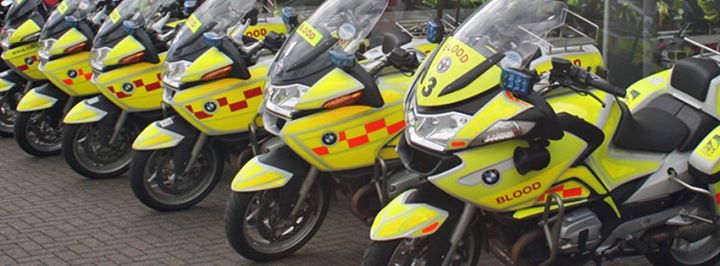
Volunteers are our lifeblood. If you want to volunteer for Freewheelers EVS, whether as a rider, fundraiser, or telephone co-ordinator, this page contains information about what you can expect. If you like what you read and want to get involved then please use our contact form to get in touch, or telephone one of the charity's officers whose numbers are on the contact page. All Freewheelers asks its volunteers to do is give their time. The charity raises money to pay all the running costs of the motorcycles and to replace them as needed. In return our volunteers get the satisfaction of a job well done, saving the NHS around £100,000 each year and in some cases helping to save lives. The excellent work of our volunteers was recognised in 2008, when the charity was given Queen's Award for Voluntary Service, which is the equivalent for a Charity of receiving an MBE. Volunteer RidersFreewheelers' motto is "Riding for Life" and our charity is focused on using motorcycles to save life, so it is not surprising that most new volunteers want to be a rider. Licence and QualificationsAll riders must be over 25 and have a full, unrestricted, motorcycle licence. A condition of our insurance is that riders must hold an advanced qualification. The most common of these is the advanced riding tests offered by the IAM and RoSPA. We will also accept a BMF Blue Riband, and riding qualifications from the emergency services. We normally require a clean licence for all new riders ; 3 points may be acceptable at the discretion of the committee. Our insurance does not cover any rider with an expired ban on their licence or with over 6 points ; if you get four to six points within 5 years then you may exceptionally be able to continue riding at the discretion of the committee and our insurers (and at a cost to the charity). Becoming a RiderThe process from getting in contact to becoming a rider is straightforward. It is described in the Induction Process document, which can be found on our downloads page.
First of all we would ask you to visit one of our meetings, details of which are on the events page. Bring along your driving licence and a copy of your advanced qualification. A certificate or other proof such as a current IAM membership card will be fine for this. Our membership secretary will take your details and get you signed up. He will also arrange for you to be added to our insurance policy. The next step in becoming a volunteer rider is for your riding to be checked. We will arrange for you to meet up with one of our ride assessors, who will follow you while you ride your own bike and check whether you would be a suitable rider. The ride will take around one hour and will cover a variety of roads and traffic situations. If the assessor is happy then he will provide some extra guidance to help you appreciate what is involved on riding with blue lights and sirens. One of our riders will arrange to take you out on a ride around the main hospitals that you will be likely to visit. Even if you know where a hospital is, this will still be useful because you will be shown key locations such as the porters lodge and pathology labs, which may be located away from the main entrance. Finally you will be asked to read and sign the Induction Brief, which can be found on our downloads page. Duty RotaOur duty rota is prepared up to 6 months in advance. Depending on which of our three bikes you ride, you will typically be on duty for a total of one week every two to three months. Rotas runs from Monday evening at 7:00pm through to Thursday morning at 7:00am, then from 7:00pm Friday to the following Monday morning at 7:00am. Riders who find it difficult to do a handover on Monday are normally able to arrange a handover on Sunday evening. Although the rota is planned well in advance, there is usually a chance for new riders to get a ride much earlier. Many changes happen during the period of a rota, due to work or domestic commitments. In these circumstances the rota co-ordinator will send out an email to all riders and ask for a volunteer to pick up a week. In addition, as a new rider you may find some of the riders on the rota will be more than willing to let you take the bike over for a weekend. What Happens During Your DutyThe Freewheelers bike stays with you at your house for the whole of your week on duty. You first job will be to arrange handover of the bike from the previous rider. This is by arrangement with the previous rider depending on whi can get lifts etc, typically by the outgoing rider taking the bike over to the new rider's house and then getting a lift home from the new rider. At the start of every week on duty you must check over the bike for things like tyre condition/pressure, brakes, lighting etc. We provide a printed checklist to make this easy for you. If there are any faults we can arrange to have them sorted out. You will need to confirm to the co-ordinator once you have possession of the bike and have completed the handover checks. For your first time on duty we encourage you to go out and ride the bike so that its handling characteristics, which may be significantly different to your own bike, do not take you by surprise on your first callout. And so to your first call... The co-ordinator will call you and give you the following details which you need to write onto the three-part job ticket provided:
When you collect you get the job ticket timed and signed, then hand over the bottom copy. When you drop off you get the ticket timed and signed again, then hand over the second copy. You keep the original copy and send it off to the secretary with your other job tickets at the end of the week. It is important that you call the co-ordinator once a job is complete and then again when you are safely home. You should also contact the co-ordinator if anything changes when you are on a job e.g. if a hospital asks you to change the priority of a job when you collect. Rider safety is our first priority and we will not send you out if we feel it would be dangerous. The rider always has the option to decline a job safety grounds. Our riders are expected to attend at least two fundraising events during the year. We also encourage you to attend the regular monthly meetings when possible, and at least once a quarter. Some of our riders also choose to help out as co-ordinators, although this is not expected. For a feel of what is involved in a typical week on duty take a look at our webmaster Mike Belch's blog. In the bike category of his blog he wrote about every call during a week on duty in September 2006: Before going on duty, Monday, Tuesday, Wednesday, Thursday, Friday, Saturday, Sunday, and finally the handover and end of week summary .
Riding Standards and ConductOur volunteer riders, while on the road on a marked up Freewheelers motorcycle, are visibly representing the charity. We expect you to ride in a manner that is professional, courteous and reflects the advanced riding qualifications you have achieved. We expect all riders to have their riding re-assessed at least once every three years. This may be through continuing involvement with RoSPA or the IAM, by an independent trainer or assessment recognised by the Committee, or in-house where necessary (although we are not primarily here to provide training or assessment). We also expect a commitment from riders to aim to achieve a riding standard equivalent to IAM Observer , RoSPA gold or equivalent. Volunteer Co-ordinatorsOur co-ordinators perform a vital role, taking calls from hospitals and dispatching the appropriate rider to respond. Co-ordinating the activities of three riders during a week with fifty plus calls can be a busy and demanding role, with every job involving a minimum of four telephone calls i.e. receiving the call from the hospital, calling the rider with the job details, receiving a call from the rider confirming drop-off and then again when the rider gets home. Of course when this happens in the middle of the night you can be tucked up safe and warm in your bed when you do this, something that the rider does not have the luxury of doing on a cold night in the middle of February! When the co-ordinator receives a call from a hospital it is his or her job to agree the call urgency. The co-ordinator should decline jobs that are trivial, that would divert a rider from more important work, or that would endanger a rider, remembering that the rider makes the final decision on whether to decline a job on the grounds of safety. The co-ordinator should be prepared to call either the pickup or drop-off hospital if anything changes while the rider is out on the job. The co-ordinator uses a call sheet to log every job, whether it is accepted or rejected. On this sheet is recorded contact details for both hospitals, call urgency, items to be transported and the times of events such as call receipt, drop-off and the time the rider got home safely. At the end of the week all these call sheets must be emailed or posted to the secretary. Although some of our riders also double up as co-ordinators at times, it is important to note that you do not have to be a rider to be a co-ordinator. This is a job that can be done by anyone with commitment, a good telephone manner and the enthusiasm to help others. You will need to ensure good telephone access during our service hours, however our incoming telephone number can be redirected to any landline or mobile phone giving you a degree of flexibility. Webmaster Mike Belch blogged his first week as a Freewheelers co-ordinator in February 2007. Take a look at the first post and follow the posts from each day to see the work that Mike and our volunteers riders did during the week: Monday, Tuesday, Wednesday, Thursday, Friday, Saturday, Sunday, End of week summary . Volunteer FundraisersIt costs us around £25,000 every year to run Freewheelers. All our riders are required to contribute with fund-raising efforts, and we also have some dedicated members who only fund-raise. As a charity we receive no funding from the NHS or the National Lottery. We rely entirely on the generosity of the public, companies and other organisations such as bike clubs, Lions and Rotary. Our fundraisers do an excellent job ensuring that this money comes in each year. Fundraising involves collections, together with our riders who are always roped in to collect, at bike shows and events such as Weston beach race. It can also involve writing to companies and other organisations seeking sponsorship. What you do to raise money is only limited by your imagination and desire to help! |
| Last Updated on Friday, 13 August 2010 16:03 |